
If you step out of Àlyde Apartments today and walk along Via Salvator Rosa, you will encounter one of Naples’ liveliest streets: cars, buses, scooters, shops, and people heading toward the city center or up the hill.
But try looking at it for a moment through different eyes.
Beneath the asphalt and the buildings, the memory of a completely different Naples still lives on.
Because before it was called Via Salvator Rosa, this street had another name: the Infrascata.
The Ancient Infrascata
The street is already recognizable in the famous view of Naples created in 1556 by Antoine Lafréry.
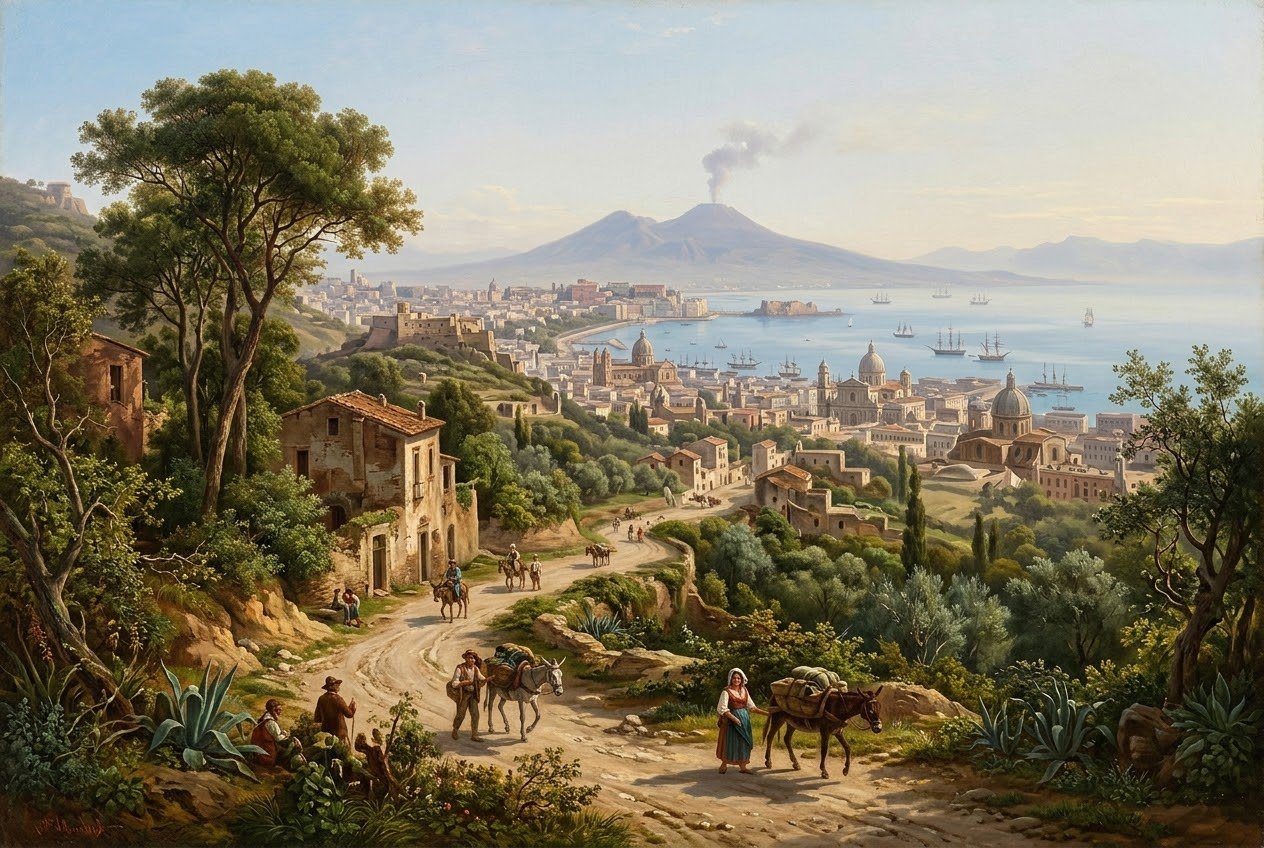
At that time, the area was still largely rural. The path connected the city with the hilly districts of Arenella, Vomero, and Antignano, traversing a landscape of fields, vineyards, and dense greenery.
The name itself, Infrascata, seems to evoke this very environment: a road passing through an area rich in foliage (frasche) and trees.
Where we find traffic and buildings today, five centuries ago you would mostly meet farmers, travelers, and pack animals.
The “Salita dei Ciucci” (Donkey Hill)
One of the most characteristic curiosities of the old Infrascata is its nickname, salita dei ciucci (the donkey hill).
Before modern transportation arrived, donkeys and mules were essential for tackling the steep climbs toward the hill and transporting people and goods.
According to tradition, there was even a sort of animal rental service in the area: anyone needing to reach the upper part of the city could hire a donkey accompanied by its driver (ciucciaro).
A true Neapolitan taxi ante litteram.
Except it had four legs.
From Countryside to City
Between the 17th and 18th centuries, the lower section of the street began to fill with buildings, while the upper part still retained its rural landscape.
Important churches, convents, and villas sprang up along this route, while the Vomero and Arenella areas were slowly transforming into summer retreats for wealthier families.
Naples was conquering the hill.
And the Infrascata became increasingly vital as a bridge between these two worlds.
The Arrival of Modernity
In the 19th century, this transformation accelerated.
The old country road became a true urban thoroughfare, and by the 1880 Schiavoni map, it appeared under the name Via Salvator Rosa.
Just a few years later came one of modern Naples’ great revolutions.
In 1888, a steam tramway line running along Via Salvator Rosa was inaugurated, using a rack railway system to tackle the steep incline.
The road that for centuries had been traveled by donkeys and mules was now seeing its first trams pass by.
It was the sign of a new Naples being born.
The Street Beneath Which History Lives
Throughout the 20th century, Via Salvator Rosa was gradually widened and better connected to Vomero and other areas of the city.
Then came the subway.
During the construction of Metro Line 1, archaeological remains were uncovered, including the ruins of an ancient Roman bridge and a neoclassical chapel.
Today, the modern Salvator Rosa station—designed by Alessandro Mendini—is one of those places where Naples seamlessly blends past and present: archaeology, contemporary art, architecture, and daily life coexist in the very same space.
Five Centuries in a Single Street
And perhaps that is the true charm of Via Salvator Rosa.
It is so much more than a busy street.
It is a timeline.
It was a country lane, a path trodden by farmers and pack animals, a link to the hillside villas, a route crossed by the first trams, and finally a modern city artery.
And today, right here, sits Àlyde Apartments.
That is why we like to think our guests aren’t simply staying on a street in Naples.
They are staying along a path that has accompanied the city through its transformation for nearly five centuries.
Next time you leave Àlyde, pause for just a moment.
Look at Via Salvator Rosa.
And imagine, for a second, stripping away the cars, the buses, and the buildings.
In their place, you will find a road immersed in greenery, a few farmers, and a donkey slowly making its way up the hill.
That was the Infrascata.
And, in some way, that Naples is still right here.